Devices: Catalogs

Summary
This page describes all the features of the Catalogs list view of the Devices screen and how to use them.
A Catalog is an index of files from a given directory referred to as the catalog path.
The Catalogs list displays all catalogs of the Collection, filtered according to the Selection.
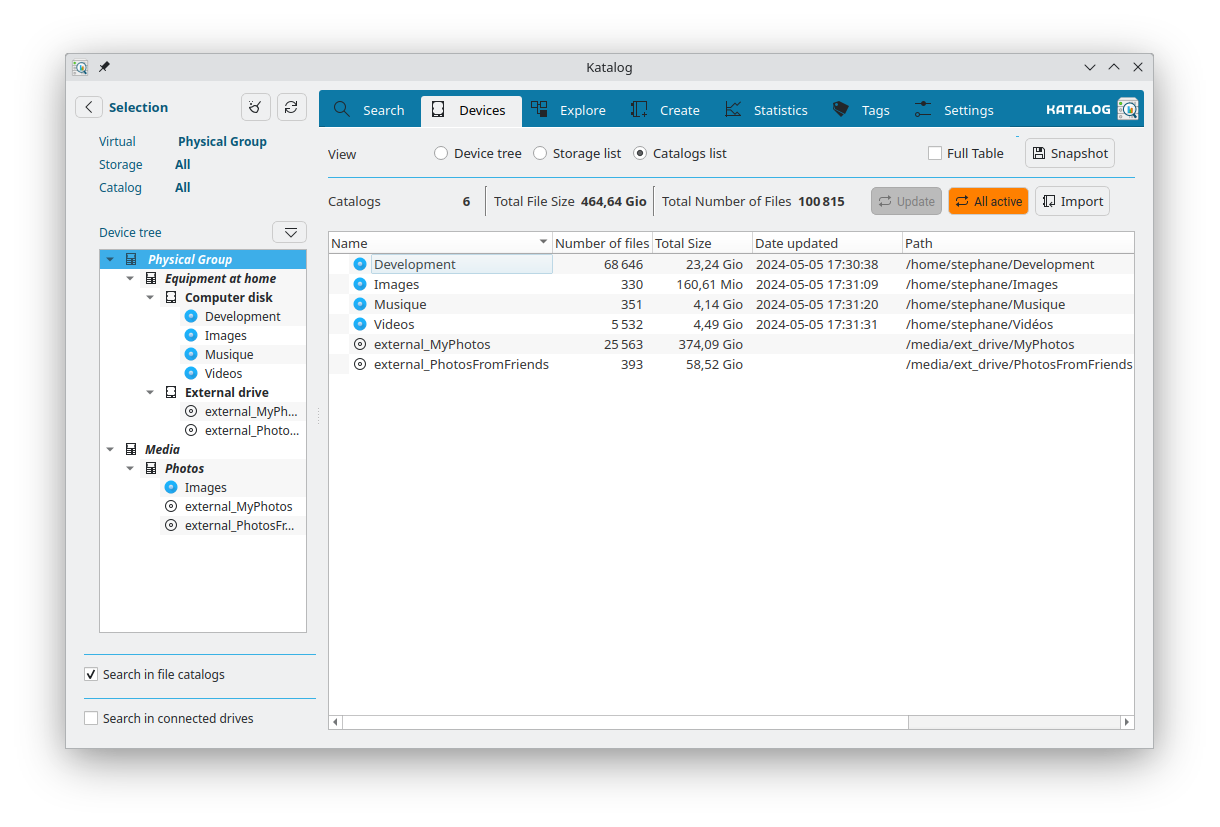
List and selection
The list of catalogs can be narrowed down using the Selection left panel.
When the source path of a catalog points to a connected and mounted location, the catalog icon is shown in color (blue), indicating the catalog is active.
Action buttons
| Button | Enabled when | Description |
|---|---|---|
| Update | A catalog is selected | Re-scans the selected catalog from its source path, according to its criteria (file type, hidden files, etc.) |
| All active | Always (Catalog list view only) | Updates all displayed catalogs whose source path is reachable |
| Stop | An update is running | Cancels the running update operation |
| Verify MIME Types | An active catalog is selected | Re-checks the file types of all files in the catalog using the system MIME database |
| Import | Always | Imports catalogs from a VVV export file — see Import below |
The All active button is only available in the Catalog list view. It is disabled when the Device Tree or Storage list view is selected.
Context menu
Right-clicking on a catalog in the list opens a context menu:
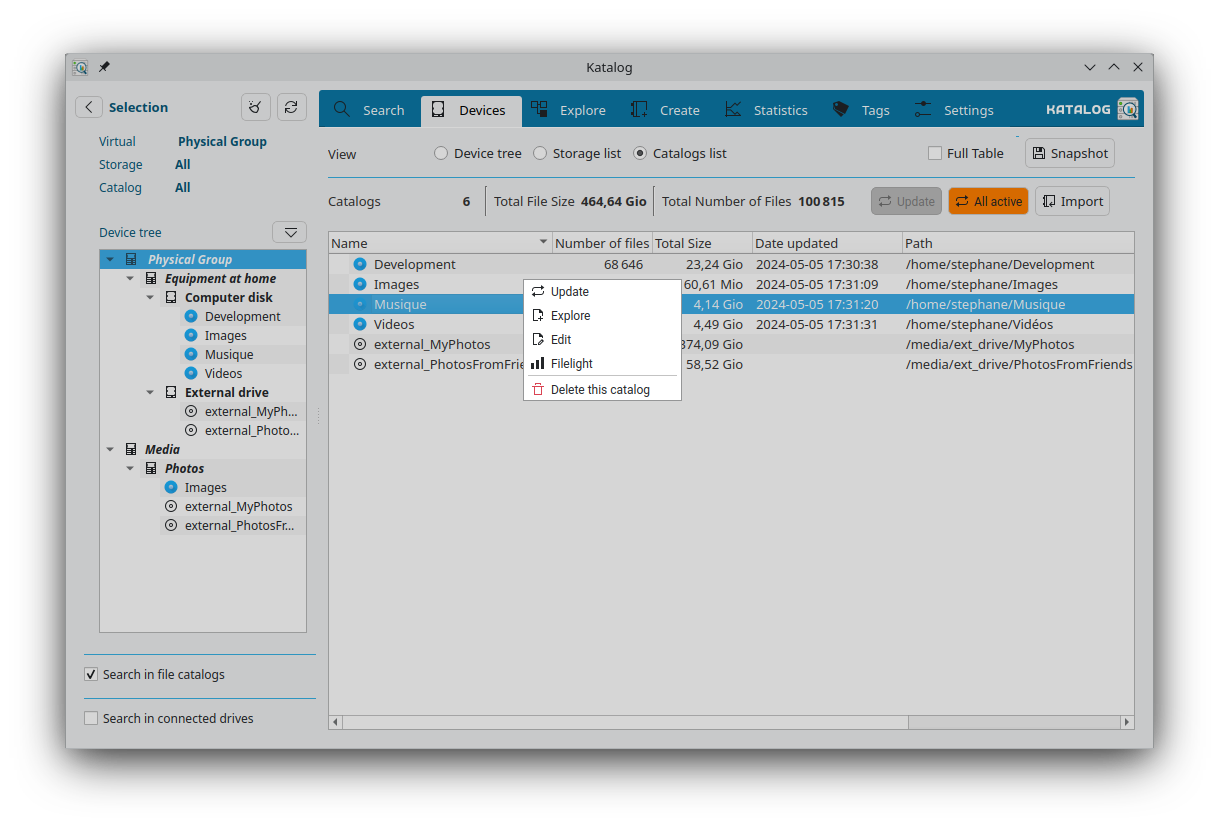
| Action | Condition | Description |
|---|---|---|
| Update | Active catalog only | Re-scans the catalog from its source path |
| Explore | Always | Opens the catalog in the Explore screen to browse its folders and files |
| Edit | Always | Opens the Edit panel to modify the catalog's settings |
| Open folder | Path is set and not an export | Opens the catalog's source folder in the file manager |
| Verify Checksums | Always | Re-calculates and compares checksums for all files in the catalog |
| Filelight | Active catalog only | Opens Filelight in the catalog's source path |
| Unassign this catalog | Catalog is assigned to a virtual group | Removes the catalog from its virtual group (the catalog itself is not deleted) |
| Delete this catalog | Physical group catalogs and exports | Permanently removes the catalog from the collection |
| Split catalog by sub-directory | Catalog device | Breaks the catalog into one catalog per immediate sub-directory plus one for root-level files — see Split catalog |
| Split catalog by file type | Catalog device | Breaks the catalog into one catalog per file type — see Split catalog |
Split catalog
Two split operations are available from the right-click context menu on any Catalog device. Both operations remove the original catalog and replace it with a set of smaller catalogs. This operation cannot be undone.
Split by sub-directory
Creates one new catalog per immediate sub-directory of the catalog's source path. Files located directly at the root level (not inside any sub-directory) are collected into a dedicated catalog named [CatalogName]_(root).
New catalog names follow the pattern [CatalogName]_SubDirectoryName.
A confirmation dialog shows the number of catalogs that will be created before proceeding.
If the catalog has no immediate sub-directories, the operation is cancelled and the original catalog is left unchanged.
Split by file type
Creates one new catalog per file type found in the catalog (Audio, Image, Text, Video, Other), using the same source path as the original. This is equivalent to creating those catalogs manually with a file type filter at creation time.
Before splitting, a dialog offers:
- Verify then Split — re-reads every file from disk using the system MIME database to ensure accurate type detection, then splits. Requires the device to be connected.
- Split without verifying — splits immediately using the file types already stored in the catalog index.
Edit
The edit panel gives access to modify the following fields:
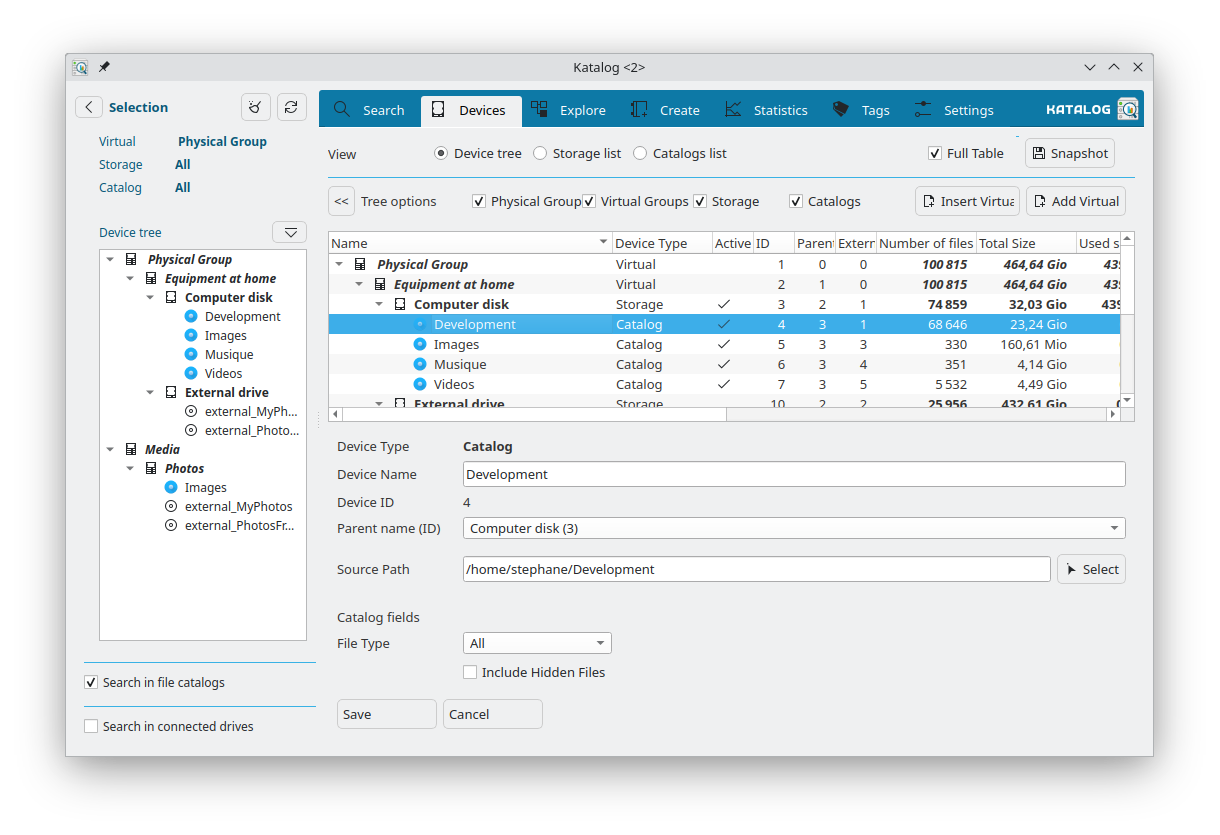
| Field | Description |
|---|---|
| Device Name | The display name of the catalog |
| Parent device | The storage device this catalog belongs to |
| Source Path | The folder path from which the catalog is built |
| File Type | Restricts the catalog to a specific file type (All, Audio, Image, Text, Video) |
| Include Hidden Files | Whether hidden files and folders are included when scanning |
| Metadata | Level of metadata indexing: None, Standard, or Extended |
| Checksum | Whether file checksums are calculated: None or SHA-256 |
| Exclude Folders | List of sub-folders to exclude from the catalog scan |
It is generally recommended to set the correct options when creating a catalog rather than editing them later.
Source path change
When the Source Path is changed and saved, Katalog detects the change and offers three options:
| Option | Description |
|---|---|
| Replace path root | Instantly updates all indexed file and folder paths by replacing the old path prefix with the new one — no rescan required, works without the device connected |
| Full re-index | Re-scans the catalog from the new source path |
| Skip | Saves the new path without modifying the catalog index |
Replace path root is the fastest option when the files have not moved and only the mount point or drive letter has changed.
Import
Catalogs can be imported from a VVV (Virtual Volumes View) export file using TAB as the separator.
Each VVV physical volume becomes one separate Katalog catalog.
Steps:
- In VVV, choose File / Export… and select TAB as the separator.
- In Katalog, go to the Catalogs list and click Import, then select the exported file.
The source path and other details about VVV volumes are not available in the export. Use the Edit panel afterward to add the source path if you want to enable future updates.
Development
Some ideas of developments for this screen:
- See the backlog of Devices development.